



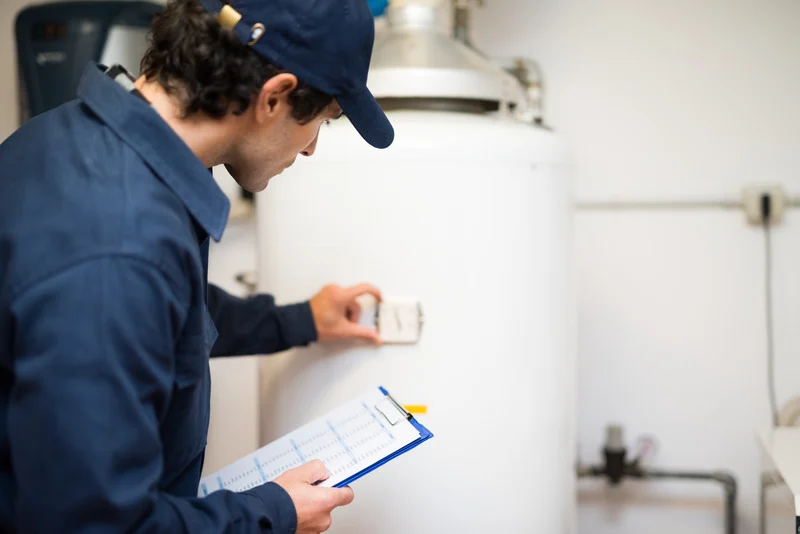
Relighting the same burner twice in one week is not bad luck. When a water heater pilot light keeps going out, a specific component has usually stopped doing its job, and in St. George garages the cause is frequently dust and lint rather than the pilot assembly itself.
The flame is only half the story, because the other half is a small sensor that has to prove the flame exists and a gas control that shuts everything down the moment it cannot. Here is how that safety chain operates and exactly where it breaks down.
How a Water Heater Pilot Light System Works
Older and mid-range gas tanks use a standing pilot, which is a small flame that burns continuously and lights the main burner on demand.
That flame performs a second job at the same time, because it heats the tip of a thermocouple, a thin metal probe that generates a tiny electrical current whenever it is hot. That current, measured in thousandths of a volt, energizes an electromagnet inside the gas control valve, and the magnet holds a safety valve open. Newer units instead use a thermopile, which is several thermocouples wired in series to produce enough voltage to run the controls as well.
The underlying logic is deliberately simple, because flame present means current present, which in turn means gas is permitted. If the flame dies the probe cools within seconds, the current collapses, the magnet releases, and the gas shuts off, which is why a water heater pilot light that will not stay lit is almost never a problem with the gas supply itself.
Why the Water Heater Pilot Light Goes Out
We work through these possibilities in order during a service call.
A Weak or Failed Thermocouple
Thermocouple tips erode after years of sitting in direct flame, and a worn probe still produces some current, just not enough to hold the electromagnet closed. The classic symptom is a water heater pilot light that lights normally, burns steadily while you hold the knob down, and then dies a few seconds after you release it.
A Clogged Air Intake Screen
Modern tanks are built around a flammable vapor ignition resistant design, where combustion air enters through a screen or filter around the base of the unit. Garage dust, lint drifting from a nearby dryer, pet hair, and the fine sand that gets into everything in Washington County pack that screen solid. Starved of combustion air, the flame lifts off the burner, turns lazy and yellow, and finally goes out, which is the most common cause we find on newer tanks.
A Dirty Pilot Orifice
The pilot burns through a tiny brass orifice, so soot, spider webbing, or scale partly blocks the opening and the flame becomes small and unstable. A pilot that looks weak and no longer wraps around the thermocouple tip cannot keep that sensor hot enough to generate current.
Draft and Backdraft
Air movement across the burner chamber simply blows the flame out, and a partially blocked flue, a strong exhaust fan pulling on the room, or wind entering a vent cap can all produce it. A water heater pilot light that fails only on windy days, or only when the laundry room fan runs, points straight at this category.
A Failing Gas Control Valve
If the thermocouple tests good and the millivolt reading falls within range while the pilot still drops out, then the electromagnet or the control board inside the valve is failing. That situation calls for a replacement part rather than a cleaning.
A St. George Scenario You May Recognize
Picture a homeowner in the Green Valley area who has relit the tank three separate times in ten days. The heater sits in the garage beside the dryer, and the garage door stays open through most afternoons.
In a case like this, pulling the outer door off the burner chamber often shows an intake screen felted over with lint and dust, while the thermocouple tests fine. Cleaning the screen, clearing the burner ports, and vacuuming the chamber fixes the problem, and checking that screen during regular cleaning keeps it from coming back. Nothing is actually broken, because the appliance is simply suffocating.
Thermocouple, Thermopile, or Electronic Ignition?
Not every gas tank uses a standing pilot, so the correct repair depends on which system you have.
- Standing pilot with thermocouple: a constantly burning flame and a single probe, which is simple, common, and the easiest arrangement to diagnose.
- Standing pilot with thermopile: the same idea with more electrical output, often paired with an electronic gas control that flashes a diagnostic code at you.
- Intermittent or hot surface ignition: no standing flame at all, because a spark or a glowing igniter fires the burner on demand while a flame sensor confirms it, so there is no water heater pilot light to relight on these units and a failure appears as a fault code instead.
If your unit flashes a coded sequence at the control, write that pattern down before calling anyone. Manufacturers such as Bradford White publish those codes by model, and the pattern frequently identifies the failed part on its own.
Safety Notes That Are Not Optional
- If you smell gas, do not relight anything at all, but leave the house and call the gas utility from outside, and Ready.gov covers home gas emergency basics.
- Never store gasoline, paint thinner, or solvents near a gas water heater, because those vapors travel along the floor directly to the burner.
- Follow the lighting instructions printed on the unit’s own label, including the waiting period before relighting, because that wait exists to clear unburned gas out of the chamber.
- Do not keep relighting a water heater pilot light that will not stay lit, since repeated attempts introduce raw gas into the burner chamber.
- Keep the area around the base clear so combustion air can actually reach the intake, because boxes stacked against the tank cause the same starvation as a clogged screen.
- Never block, cap, or modify the vent connector in an attempt to improve draft.
What You Can Check Before Calling
- Look at the flame color through the sight glass, because a healthy water heater pilot light burns mostly blue and wraps itself around the probe tip.
- Look for dust accumulating around the base of the tank and across the intake screen.
- Note whether the failures line up with windy days, a running exhaust fan, or a dryer cycle.
- Check that nothing has been stacked against the heater or the vent connector.
- Count the days between failures, because a fast repeat pattern and a slow one point toward different causes.
Bring those observations to the call, because they shorten diagnosis considerably, and our gas water heater page explains the rest of what we inspect.
When to Call a Professional
Call when the pilot fails more than once, when the flame burns yellow or lifts off the burner, when you see soot around the draft hood, or when the failures follow wind and fan use. Call immediately for a gas odor, a scorched jacket, or any sign of combustion spilling into the room, because carbon monoxide is a genuine hazard with any fuel-burning appliance and the U.S. Consumer Product Safety Commission publishes homeowner guidance on detectors and appliance safety.
Frequently Asked Questions
Is it safe to keep relighting the pilot myself?
Relighting once, following the label instructions carefully, is reasonable. A water heater pilot light that goes out repeatedly is signaling an underlying fault, and repeated relighting introduces unburned gas into the chamber without fixing anything.
Can I clean the intake screen myself?
Careful vacuuming around the base helps on many models. Anything requiring removal of the burner assembly belongs with a technician, because that assembly has to be reseated correctly to maintain its seal.
Why does my pilot only go out on windy days?
That pattern points directly at draft, because wind at the vent cap, a partially blocked flue, or an exhaust fan depressurizing the room can each pull the flame off the burner.
Would a tankless unit solve this?
Tankless units use electronic ignition with no standing pilot, so there is nothing to relight at all. They do bring their own maintenance requirements, mainly scale inside the heat exchanger, and ENERGY STAR covers certified tankless gas models.
Book a Burner Inspection
If you are relighting the same tank again and again, stop guessing and have the entire safety chain tested properly. Call St George Water Heaters or reach us through our contact page with the age of the unit and how often the flame drops out.
We will read the thermocouple output, inspect the intake screen and the burner, check draft at the hood, and tell you whether your water heater pilot light problem is a cleaning, a part, or a control valve. Our water heater service page covers what else the visit includes.