



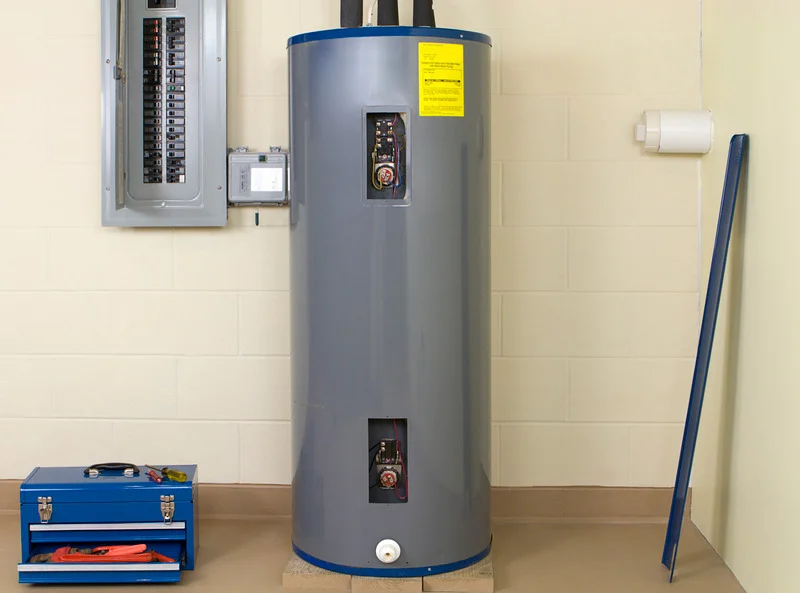
If the shower went cold this morning and your tank runs on electricity, the odds are strong that an electric water heater element has burned open somewhere inside it. Elements are the simplest components in the entire appliance and the ones most affected by the hard water in St. George.
They are also parts that often get replaced twice, because the scale that ruined the first one is still in the tank waiting for the replacement. Here is how an element fails and how the upper and lower positions produce different symptoms. You will also see what a technician checks before reaching for a new part.
What an Element Is and How It Heats
An electric tank has no burner and no flue. Instead it carries two immersion elements screwed through the side of the tank, one near the top and one near the bottom, each sitting directly in the water.
Inside the metal sheath of each element is a coil of resistance wire packed in insulating powder. Electricity forces its way through that wire, the wire resists, and the resistance releases heat that the sheath transfers into the surrounding water. Nothing moves and nothing burns, so the entire design depends on one condition: water must remain in constant contact with the outside of the sheath to carry that heat away.
Break that single condition and the element destroys itself. That is the mechanism behind most electric water heater element failures.
The Three Ways an Element Dies
Scale Insulation
Hard water deposits calcium and magnesium onto every hot surface, and the element sheath is the hottest surface anywhere in the tank. As scale thickens it behaves like a ceramic jacket, so heat cannot leave the sheath fast enough. The internal temperature climbs past what the resistance wire tolerates, and the wire eventually burns open. The U.S. Geological Survey explains how mineral hardness is measured, and water throughout this region sits well up that scale.
Dry Firing
If the tank has been drained, or the water level drops below an element while the breaker remains on, that element is heating air rather than water. Air carries almost no heat away, so an exposed electric water heater element can burn out within seconds. This is a common way a do-it-yourself flush turns into a repair call.
Sediment Burial
The lower element sits closest to the sediment bed. Once grit packs around it, sediment insulates the element instead of circulating water cooling it, so it overheats along the buried section. Elements that fail this way usually come out of the tank with a scorched band across the lower loop.
Upper or Lower? What the Symptom Tells Us
Most residential electric tanks use non-simultaneous control, meaning only one element is energized at a time and the upper thermostat holds priority. That design creates symptoms you can read from your own bathroom.
- A little hot water, then cold, with recovery that takes forever: this is a classic failed lower electric water heater element. The upper element is heating only the top portion of the tank.
- No hot water at all, ever: this points toward the upper element, the upper thermostat, a tripped high limit, or a lost leg of incoming power.
- Lukewarm water all day that never gets truly hot: this is often a thermostat out of calibration, or an element partly shorted to the tank body.
- Hot water that stops mid-shower and returns hours later: this suggests the high limit is tripping and then resetting itself.
The high limit, often called the ECO, is a thermal cutout behind the upper access panel with a red reset button. It cuts power whenever water temperature runs away. A tripped ECO is a symptom rather than a repair, so pressing that button without determining why it tripped simply hands you the identical failure a day later.
A St. George Scenario You May Recognize
A homeowner near Dixie Downs flushes the tank for the first time in years, turns the water back on, and flips the breaker before the tank has completely refilled. Ten minutes later there is no hot water anywhere in the house.
What happened is dry firing, because the upper element was still exposed to air when it energized and burned open almost immediately. The flush itself was the right idea and the order of operations was the problem, so the visit now includes an element replacement alongside the tune-up. Filling completely, purging air at a hot tap, and only then restoring power avoids that entire sequence.
Element, Thermostat, or Power? How We Tell Them Apart
A technician separates these possibilities with a meter rather than by guessing at them.
- Element: tested for continuity across the terminals with power off. An open reading means the resistance wire has burned through and a reading to the tank body means it has shorted to ground.
- Thermostat: checked for correct switching as temperature changes, because a thermostat can fail closed, which overheats, or fail open, which produces no heat at all.
- High limit: checked for continuity first and then investigated for whatever caused it to trip.
- Supply: both legs of the circuit are verified at the terminal block, because electric tanks run on a double breaker and losing one leg leaves the appliance half dead.
Only after completing those checks does replacing parts make any sense, and our electric water heater page covers the service in more detail.
Safety Notes
- Electric tanks carry high voltage at the terminal block, so turn off the breaker and verify it is genuinely off before removing an access panel.
- Never restore power until the tank has completely refilled and the air has been purged from the lines.
- Water inside the tank will scald, so let it cool before draining and route the hose somewhere safe.
- Never cap or block the temperature and pressure relief valve, even temporarily while working.
- Do not raise the thermostat above the setting printed on the unit’s label, because hotter water scalds faster and accelerates scale formation on the elements.
Element Replacement or New Tank?
Replacing an element on a structurally sound tank is routine work, and the decision only becomes complicated once the tank itself is aging.
- Worth repairing: a younger tank with an intact anode rod, modest sediment, and a first element failure.
- Time to plan replacement: repeated element failures, heavy sediment, corroded fittings, rust appearing in the hot water, or weeping at the seams.
If the tank is genuinely near the end of its life, many homeowners prefer to put the work into a new unit instead. ENERGY STAR publishes efficiency information on heat pump water heaters, the high-efficiency option for electric homes, and its Save at Home guide covers other efficiency upgrades around the house.
When to Call a Professional
Call when you have no hot water while the breaker is on, or when the high limit trips more than once. Also call when hot water runs rust-colored or you notice moisture under the tank. Call right away for burning smells, scorch marks near the access panels, or a breaker that trips the instant it is reset. Those symptoms point to a shorted electric water heater element or a wiring fault that needs attention before anything is powered again.
Frequently Asked Questions
How long does an electric water heater element last?
There is no fixed lifespan, because scale, sediment, and tank temperature drive the outcome. In general, elements in tanks that are never flushed fail sooner than elements in tanks that get regular maintenance, and the hard water in St. George speeds that up.
Can I replace just one element?
You can, and frequently that is all the repair requires. Many technicians test both elements while the panels are already open, since the second one is the same age and has lived in exactly the same water.
Why did my new element fail so quickly?
Usually because nobody removed the underlying cause. A thick sediment bed or a scale-heavy tank will coat a new electric water heater element quickly and repeat the original failure.
Does a tankless unit have elements like this?
Electric tankless models do use elements, but they are built for flowing water rather than a storage tank. Scale shows up there as flow and temperature faults instead of a dead tank.
Get the Tank Tested
If your electric tank has stopped making hot water, the fastest path forward is a meter on the elements and the thermostats rather than a guess at the parts counter. Call St George Water Heaters or send the details through our contact page, including the age of the tank and what the hot water has been doing.
We will test each electric water heater element, check the thermostats and the high limit, and evaluate the sediment in the tank. Then we will tell you whether a repair or a replacement makes better sense. Our water heater service page explains the rest of the visit.