



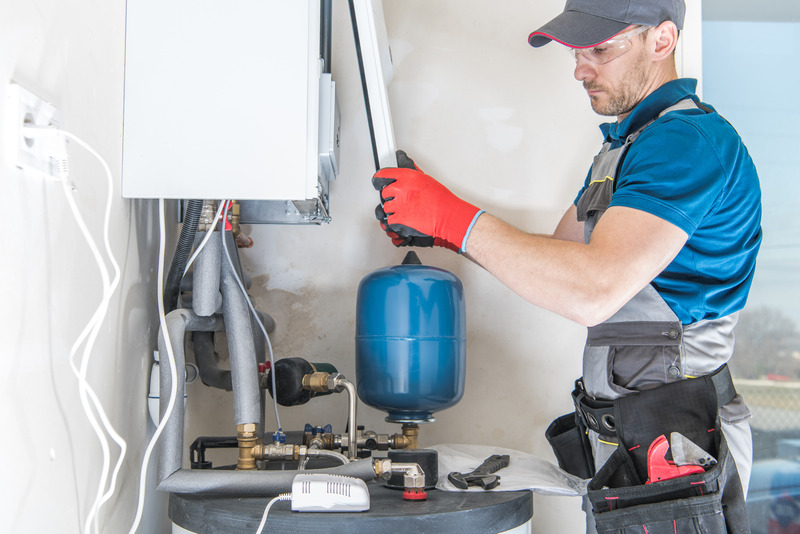
That small tank bolted to the pipe above your heater is not decoration, and it does not last forever. A water heater expansion tank absorbs the extra volume created every time your heater warms a full tank of water, and when it quits working, that pressure has to relieve itself somewhere else.
In St. George homes the consequence is usually a dripping relief valve, banging pipes, or faucet cartridges that fail years early. Here is exactly what the component does, how it fails internally, and the two minute check that tells you which side of that line yours is on.
Why Homes Need One at All
Water expands as it heats, which is unavoidable physics, and a full tank gains noticeable volume during every heating cycle.
In older plumbing that extra volume simply pushed back out through the cold line into the city main, which acted as an infinite relief path. Many services in this area now include a pressure reducing valve, a backflow preventer, or a check valve at the meter, and any one of those turns your plumbing into a closed system where expanding water has nowhere to escape.
Pressure then climbs sharply on each cycle. A water heater expansion tank gives that volume somewhere to go, which is why current plumbing codes, maintained by organizations such as IAPMO, require expansion control on closed systems.
How a Water Heater Expansion Tank Works
Inside the steel shell sits a flexible rubber diaphragm, sometimes a full bladder, dividing the tank into two separate chambers.
- The water side connects directly to the cold supply line near your heater.
- The air side holds a pressurized air charge, accessible through a Schrader valve that looks exactly like a tire valve.
Air compresses while water does not, so when heating pushes extra volume into the tank, the diaphragm flexes and squeezes the air cushion, absorbing that expansion without a pressure spike. When you subsequently draw hot water, the compressed cushion pushes the stored volume back out.
The critical detail is the pre-charge, because the air pressure has to match the static water pressure of your particular house. Set too low, the diaphragm sits collapsed and the tank fills with water, while set too high, the diaphragm never moves and the tank accomplishes nothing whatsoever.
How the Tank Fails
Two failure modes account for nearly everything we encounter on a service call.
- The air charge leaks out: Schrader valves weep slowly, sometimes across a span of years, and as air escapes the shell fills with water and the cushion disappears entirely.
- The diaphragm tears: rubber that flexes thousands of times eventually splits, which admits water into the air chamber and produces a completely waterlogged tank.
A waterlogged water heater expansion tank is effectively a solid lump of water hanging on the end of a pipe, and it cannot absorb anything at all. The plumbing then behaves exactly as though no expansion control had ever been installed, and the pressure returns to the relief valve.
What Waterlogging Looks Like Downstream
- The temperature and pressure relief valve discharges after heating cycles and then stops.
- Faucets spit or hammer noticeably when they are first opened.
- Toilet fill valves and faucet cartridges fail considerably sooner than they should.
- The expansion tank feels equally cold across its whole surface and unusually heavy when you tap it.
The Two Minute Test
You can check this yourself without any tools at all.
- Tap the shell: a healthy tank rings hollow across the upper half and sounds dull across the lower half, while a waterlogged one sounds dull everywhere you tap it.
- Feel the temperature: the water side warms during a heating cycle while the air side should stay closer to room temperature, so a uniformly warm shell suggests water on both sides of the diaphragm.
- Press the Schrader valve briefly: air means the bladder is intact, while water squirting out means the diaphragm has failed and the tank requires replacement.
- Check the mounting: tanks mounted horizontally on an unsupported nipple put continuous stress on that fitting and eventually leak at the threads.
Checking the pre-charge against measured house pressure requires a gauge and a compressor, which is part of what we bring to a service visit.
A St. George Scenario You May Recognize
Picture a homeowner in Washington with a relief valve dripping every evening. There is already an expansion tank overhead, installed alongside the heater six years earlier, so the assumption is that expansion is covered. But tap that tank and it sounds dead all the way up, and pressing the air valve produces water instead of air.
That means the diaphragm is torn, the tank has been waterlogged for an unknown period, and the relief valve has been absorbing thermal expansion on its own the entire time. Replacing that water heater expansion tank and setting the new pre-charge to match static house pressure is what stops the evening drip.
Expansion Tank or Pressure Problem? How We Tell
Not every pressure symptom originates at the expansion tank, so we work through the alternatives methodically.
- Failed expansion tank: discharge after heating cycles, a waterlogged shell, and house static pressure measuring within a normal range.
- High incoming pressure: pressure that reads high at all times, even with nothing heating, which points at the pressure reducing valve rather than at the water heater expansion tank.
- Failed relief valve: a constant slow weep bearing no relationship to heating cycles, frequently on a tank carrying heavy scale.
- Incorrect pre-charge: the tank itself is healthy, but the air setting does not match house pressure, so it barely participates in the system.
Sorting those apart requires a pressure gauge on a hose bibb and a heating cycle to observe, and our plumbing services include that supply-side testing.
Safety Notes
- Never cap, plug, or valve off the relief valve discharge line to stop a drip, because that valve is the last protection a pressurized tank has.
- Support the tank properly, since a waterlogged unit weighs far more than an empty one and unsupported tanks tear out of their fittings.
- Depressurize the line before removing a tank and expect residual hot water, because scald injuries happen during rushed work.
- Do not add air pressure without measuring your static house pressure first, because guessing at the pre-charge renders the tank useless.
- Follow the mounting orientation in the manufacturer’s instructions, and makers such as Rheem specify how their tanks are to be installed.
When to Call a Professional
Call when the relief valve discharges on a schedule that follows your hot water use, when the expansion tank sounds dull all over, or when water comes out of the Schrader valve. Call sooner if fixtures are hammering, because sustained pressure spikes damage considerably more than the heater itself.
The EPA WaterSense program and the Plumbing-Heating-Cooling Contractors Association both publish homeowner material on maintaining household plumbing systems.
Frequently Asked Questions
Does every home need a water heater expansion tank?
Only closed systems require one, though closed systems are common wherever a pressure reducing valve, check valve, or backflow preventer sits at the meter. If your relief valve discharges after heating cycles, treat that as evidence your system is closed.
How long does an expansion tank last?
There is no fixed number, because longevity depends on pre-charge accuracy, pressure swings, and water chemistry. The honest approach is testing the tank during routine service rather than counting years on a calendar.
Can a waterlogged tank damage anything besides the heater?
It certainly can, because repeated pressure spikes shorten the life of faucet cartridges, fill valves, and supply hoses throughout the house. That is why fixture repairs often cluster in homes with failed expansion control.
Can I recharge the air instead of replacing the tank?
If the diaphragm remains intact and the charge simply leaked down, adding air to the correct pressure can restore normal operation. If water comes out of the air valve, the diaphragm has torn and no amount of air will fix it.
Have Yours Tested
If your relief valve drips in the evening or your pipes bang when a faucet opens, the expansion side of your system is the first place to look. Call St George Water Heaters or reach us through our contact page and describe when the dripping happens.
We will measure static pressure, test the water heater expansion tank charge, and either replace or recharge it based on what the gauge actually shows. Our water heater service page covers what else we inspect while we are there.