



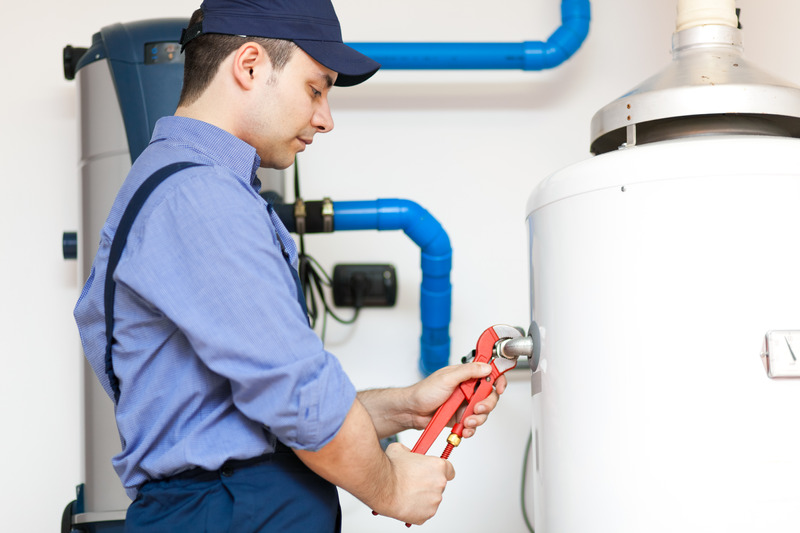
A puddle underneath the discharge pipe is one of the calls we take most often in St. George, and it is one of the few water heater symptoms that is genuinely a safety matter rather than an inconvenience. A dripping water heater relief valve is not a nuisance part misbehaving, it is a safety device reporting that pressure or temperature inside the tank exceeded its limit, or that the valve itself can no longer seal.
Here is what the valve actually does, the four reasons it opens, and why nobody should ever cap it.
What the Water Heater Relief Valve Does
The full name is the temperature and pressure relief valve, which technicians shorten to T and P. It threads into the top or the upper side of the tank, with a probe extending into the water and a discharge pipe running down toward the floor.
Inside the body are two entirely separate triggers.
- The pressure side: a spring holds a disc against a seat, and when tank pressure climbs above the valve’s set point the spring is overcome, the disc lifts, and water escapes until pressure falls back into range.
- The temperature side: a probe sitting directly in the hot water expands when the water becomes too hot and mechanically pushes that same disc open.
The set points are stamped onto the valve tag, and that tag is the authority for your specific valve. The purpose of the assembly is straightforward, because water expands when heated while steel tanks do not, and a sealed tank with no escape path can fail violently. The water heater relief valve is that escape path.
Why a Water Heater Relief Valve Discharges
Four causes account for most of these cases.
Thermal Expansion in a Closed System
This is the most common cause in newer St. George homes, and it starts with the fact that heated water expands. In an older house that extra volume simply pushed backward into the city main, but modern services often include a pressure reducing valve, a backflow preventer, or a check valve at the meter, and any of those devices converts the house into a closed system.
The expanding water now has nowhere to go, so pressure spikes on every heating cycle and the water heater relief valve vents the difference. The classic symptom is a brief discharge shortly after the burner or element runs, followed by nothing at all in between cycles.
High Static Pressure From the Supply
If incoming pressure is already high, even normal expansion pushes the valve past its set point. A gauge on a hose bibb tells us quickly whether the entire house is running high, which makes it a plumbing problem rather than a water heater problem. IAPMO, the plumbing and mechanical code body, publishes the standards governing how these systems are supposed to be protected.
Overheating
If a thermostat or a gas control fails to shut off, the water keeps heating and the temperature probe opens the valve deliberately. Continuous or steaming discharge is the serious version of this symptom and should be treated as an emergency.
A Worn or Scaled Valve
Hard water leaves mineral deposits on the seat, and once scale, grit, or corrosion prevents the disc from seating flat, a water heater relief valve weeps even at completely normal pressure. Age accomplishes the same thing on its own, particularly on a valve that has never once been exercised.
A St. George Scenario You May Recognize
A homeowner in Little Valley notices a stain on the garage floor underneath the discharge pipe, dry through most of the day and damp in the early evening. That timing matters enormously, because evening is when the dishwasher and the showers pull hot water, the burner fires to recover, and tank pressure reaches its peak.
Dry by morning and damp after a heating cycle is the signature of thermal expansion in a closed system rather than a failed valve. Swapping the valve in that house would solve nothing, because the replacement would do the same job for exactly the same reason.
Thermal Expansion or a Failed Water Heater Relief Valve?
- Discharges only after a heating cycle, then stops: this points toward thermal expansion, so we check for a pressure reducing valve or check valve at the meter and determine whether an expansion tank is present and functioning.
- Drips constantly and slowly: this points toward a valve that will not seat, or toward house pressure that is running high all the time.
- Discharges hot water or steam continuously: this points toward overheating, so shut off the fuel or the breaker and call right away.
- Started right after new plumbing work: this points toward a newly closed system or a changed pressure setting somewhere upstream.
- Old tank with an original valve nobody has touched: this points toward scale accumulating on the seat.
The diagnosis changes the repair completely, which is why we test pressure before replacing any parts, and our plumbing services cover the supply-side testing that goes with this work.
Never Cap a Water Heater Relief Valve
This is the one absolute rule in this article, so do not thread a plug, a cap, or a shutoff into the discharge line, and never replace the valve with a fitting.
- It is the only device preventing a sealed, overheating tank from failing under pressure.
- A capped discharge line conceals the symptom while the underlying pressure problem continues building behind it.
- Codes require the discharge pipe to run to a safe termination with an open end, so that water can escape freely and so that a discharge remains visible to somebody.
The U.S. Consumer Product Safety Commission has published warnings about home appliance hazards for decades, and pressure vessels sit near the top of that list. If the drip annoys you, fix the underlying cause rather than blocking the outlet.
Safety Notes
- Discharge water is hot enough to scald, so keep children and pets well away from the termination point.
- Test the valve only if you accept that it may not reseat afterward, because lifting the lever on a scaled old valve frequently turns a drip into a steady stream.
- Never leave a discharge pipe terminating above head height, aimed at a person, or inside a sealed container of any kind.
- If you smell gas near the unit, or you see steam at the discharge, leave the area and call from outside the house.
- Keep the thermostat at the temperature printed on the unit’s label.
When to Call a Professional
Call when the discharge is continuous, when it runs hot or steaming, when the valve has never been replaced on an older tank, or when the drip began immediately after other plumbing work. Call immediately for steam or for a rapidly climbing tank temperature.
Replacing a water heater relief valve is straightforward work, but replacing it without identifying the cause only resets the clock on the same failure. Manufacturers including Rheem publish the valve specifications required for each model, and the replacement has to match those specifications exactly.
Frequently Asked Questions
Is it normal for the valve to drip a little?
It is not normal, because occasional discharge during heating points at a pressure control problem while a steady drip points at a valve that can no longer seal. Either way, a water heater relief valve should be completely dry during normal operation.
Will an expansion tank stop the dripping?
If the underlying cause is thermal expansion in a closed system, a correctly sized and correctly charged expansion tank gives that extra volume somewhere to go. It accomplishes nothing when the real problem is a failed valve or an overheating tank.
How often should the valve be replaced?
Manufacturers publish a service interval for each model and the valve tag lists its ratings. Most technicians treat a valve that has never been serviced on an aging tank as overdue for inspection.
Can I just shut off the water supply to stop it?
You should not, because closing the cold supply does not stop the heater from heating and it removes the path that lets pressure equalize. Turn off the heat source instead, and then call for service.
Get the Cause Diagnosed
If water is appearing underneath your discharge pipe in St. George or Washington, the valve is doing its job and something upstream needs attention. Call St George Water Heaters or message us through our contact page with a description of what you are seeing and when it happens.
We will test static pressure, determine whether your system is closed, inspect the water heater relief valve and its discharge line, and fix the cause instead of the symptom. Our water heater service page explains what that visit covers.