



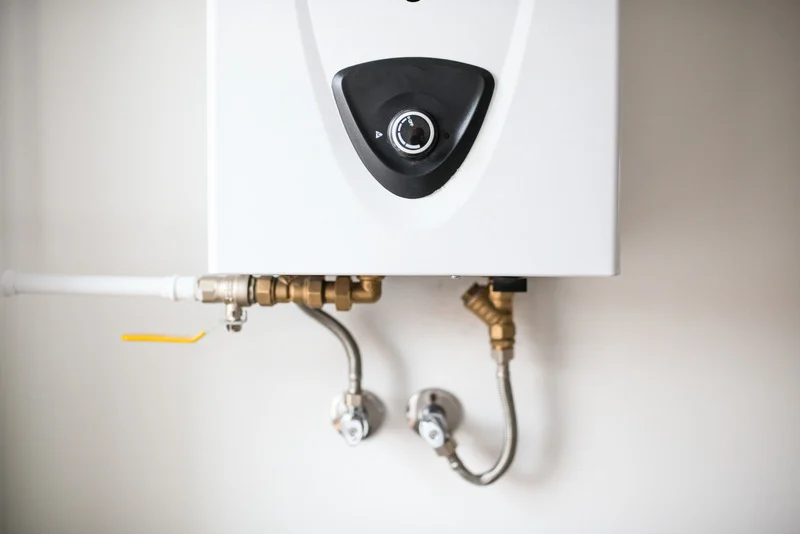
A tankless unit has no storage tank to fill with sediment, which leads plenty of homeowners to assume that hard water cannot touch it. The opposite is true. Tankless water heater scale forms faster than tank scale, because the surfaces inside a tankless unit run hotter than anything in a storage heater.
In St. George, with heavily mineralized water and no winter break from demand, that buildup is the most common reason a tankless unit begins swinging between hot and cold. Here is what is physically happening inside the heat exchanger and how we clear it out.
What the Heat Exchanger Does
A tankless heater stores nothing at all. When you open a hot tap, a flow sensor detects the movement, the control board fires the burner, and water is heated during a single pass through the unit.
That pass happens inside a heat exchanger, which is a compact block of copper or stainless steel containing narrow passages and sitting directly above the burner. The water has one short trip in which to gain all of its temperature. So the metal surface has to run extremely hot, and the passages are kept narrow to maximize contact between water and metal.
Both of those design choices, high surface temperature and narrow channels, are precisely the conditions that produce tankless water heater scale.
How Tankless Water Heater Scale Forms
Calcium and magnesium stay dissolved in cool water. Heating makes them much less soluble, so they come out of the water onto the hottest surface available. In a storage tank that surface is the bottom of the vessel or the element, while in a tankless unit it is the inner wall of the heat exchanger.
The resulting buildup then creates three separate problems.
- Insulation: scale conducts heat poorly, so the burner has to work harder to push the same heat through. The exchanger wall runs hotter as a result, which drops out still more minerals and speeds up the process.
- Restriction: narrow passages become narrower, so flow through the unit drops and pressure at the fixture falls along with it.
- Hot spots: uneven deposits create localized overheating, and the control board responds by throttling the burner or shutting it down on a fault code.
The U.S. Geological Survey explains how water hardness is measured, and this region sits well toward the high end of that range.
Symptoms of Tankless Water Heater Scale
- Water temperature swinging between warm and hot during a single shower.
- Reduced hot water flow at every fixture, while the cold side flows normally.
- The burner cycling off and on in short bursts while a tap is running.
- Error codes relating to overheating, flow, or ignition appearing on the display.
- A noticeably longer wait for hot water than the unit used to require.
- A rumbling or kettling sound coming from inside the cabinet.
Cold flow remaining normal while hot flow drops is the clue that separates this from a house-wide pressure problem.
Tankless Water Heater Scale and the Flow Sensor
The second component that scale attacks is the flow sensor. It is a small turbine wheel that spins as water passes and tells the control board how much water is moving.
Every tankless unit has a minimum activation flow. Below that threshold the burner will not fire at all, which protects the exchanger from overheating in nearly still water. When mineral deposits create drag on that turbine, the sensor under-reports flow. The board then either sees numbers below the minimum and refuses to light, or it misjudges how much heat the water needs and overshoots.
That is why a unit carrying heavy tankless water heater scale usually fails first at low-flow fixtures. A bathroom faucet opened partway goes cold while a full shower still works normally.
A St. George Scenario You May Recognize
A family in Washington installed a tankless unit roughly four years ago and has never once had it serviced. This summer the kitchen sink runs hot, then lukewarm, then hot again while the dishwasher is filling. The shower works fine on full blast but goes cold whenever anyone turns it down.
The unit also throws an occasional code that clears itself. In a case like this, the usual finding is a heat exchanger lined with tankless water heater scale and an inlet screen packed with fine grit, so nothing is actually broken. The unit is doing exactly what its safety logic requires with the flow information it currently has.
Descaling, Filtration, and Treatment Compared
There are three different levers available here, and each one solves a different part of the problem.
- Descaling: a pump circulates a food-grade descaling solution through the exchanger by way of the isolation valves. It dissolves deposits that have already formed, which restores lost performance but prevents nothing going forward.
- Inlet filtration: a screen or filter at the cold inlet catches grit and protects the flow sensor and the exchanger from debris. Dissolved minerals pass straight through a filter, though, and still form tankless water heater scale.
- Whole-house water treatment: reducing hardness before water reaches the appliance addresses the root cause. That is a separate decision about your whole plumbing system rather than the heater alone.
Manufacturers publish their own maintenance intervals and approved solutions, and both Rinnai and Navien document the procedure for their equipment, where following the maker’s instructions matters for warranty coverage.
How Often Should a Tankless Unit Be Flushed?
There is no universal answer, because the interval depends on hardness, household usage, and inlet temperature. Homes on untreated hard water around St. George and Washington tend to build tankless water heater scale faster than general recommendations written for average water assume.
If your unit already has isolation valves installed, the service is straightforward. If it does not, adding them is the first step, and our tankless water heater page explains it in detail.
Safety Notes
- Shut off gas and power at the unit before opening the cabinet or connecting any hoses to it.
- Use only the descaling solution your manufacturer approves, because strong acids can damage a heat exchanger permanently.
- Never bypass or defeat a fault code to keep a unit running, since overheat codes exist to protect the exchanger and the house.
- Keep the vent termination clear of shrubs and stored items, and never modify the vent path in any way.
- Do not raise the set temperature to compensate for weak performance, because hotter water scalds faster and deposits minerals faster as well.
When to Call a Professional
Call when temperature swings during a shower or when hot water flow has dropped noticeably. Also call when the display shows repeated error codes, or when the unit has never been descaled since installation. Call sooner for any gas odor, water inside the cabinet, or a burner that refuses to stay lit.
A technician records the fault history and checks the inlet screen and the flow sensor. Flow is measured before and after descaling, so the effect of removing tankless water heater scale is visible rather than assumed. Efficiency details on certified models are published by ENERGY STAR.
Frequently Asked Questions
Can tankless water heater scale be reversed, or is the unit ruined?
In most cases descaling restores performance completely, because the mineral deposits dissolve. Damage only becomes permanent when scale has caused repeated overheating and the exchanger itself has been compromised.
Will a water softener stop it completely?
Reducing hardness slows deposit formation considerably, which is why homes on treated water go much longer between flushes. Most manufacturers still specify periodic maintenance regardless of water quality.
Can I descale the unit myself?
Homeowners certainly do, provided isolation valves are already installed and the manufacturer’s procedure is followed exactly. The steps that typically go wrong are the wrong solution, too short a dwell time, and forgetting to clear the inlet screen afterward.
Does scale affect electric tankless units too?
It does, because the mechanism is identical, with deposits forming on the heating elements instead of inside a gas-fired exchanger. Water chemistry does not care what fuel the unit happens to burn.
Schedule a Tankless Flush
Is your tankless unit swinging between hot and cold, or has it never been serviced since the day it was installed? Then tankless water heater scale is the first thing to rule out. Call St George Water Heaters or reach us through our contact page with the brand, the approximate age, and any error code showing on the display.
We will check the inlet screen and flow sensor, descale the heat exchanger using the solution your manufacturer approves, and confirm the result by measuring flow and temperature afterward. Our water heater service page covers what else we inspect during the visit.